My take
Shallow work is not a smaller version of deep work, it's a fundamentally different activity. If you can't focus deeply, you can't produce anything that matters.
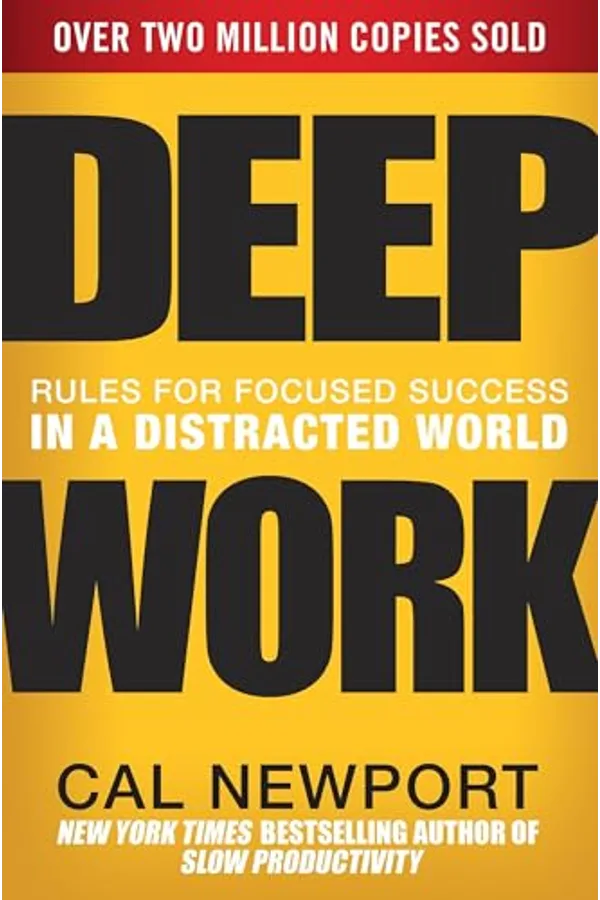
What is Deep Work about?
Deep work, cognitively demanding, distraction-free focus, is becoming simultaneously more valuable and more rare. Mastering it is the key competitive advantage.
Who should read Deep Work?
Builders, creators, and knowledge workers who feel the constant pull of shallow tasks and want to reclaim their capacity for meaningful output.
Key ideas from Deep Work
- Schedule deep work, it won't happen by default
- Embrace boredom, your brain needs it to rebuild focus capacity
- Quit or dramatically reduce social media consumption.
Is Deep Work worth reading?
The antidote to the attention economy, directly relevant for anyone whose livelihood depends on producing high-quality work.
Best for
Builders, writers, and developers whose output quality depends on sustained concentration and who feel their attention being farmed.
Not ideal for
Roles that are inherently reactive, support, most management,coordination-heavy work, Newport underweights how much modern work genuinely is this.
What materially matters
- The deep-versus-shallow taxonomy that names what the attention economy keeps blurring.
- Four scheduling philosophies, monastic, bimodal, rhythmic, journalistic, so the rules fit a real life.
- Attention-residue research (Sophie Leroy) behind the switch-cost argument, plus the case for embracing boredom.
Practical use cases
- Design a weekly rhythm with protected deep blocks and a fixed end time.
- Set a shallow-work budget per week and audit which meetings and feeds actually earn their slice.
Pros
- Practical rules that survive contact with a calendar, rhythmic scheduling alone is life-changing.
- Honest that focus is trainable: the boredom drills treat concentration like a skill, not a trait.
Limitations
- Dismisses collaborative and serendipitous work too quickly; some careers genuinely run on weak ties.
- Examples skew academic, professors and writers, and need translation for business contexts.
Deep Work FAQ
Is it anti-social-media and anti-remote?
It is anti-default, not anti-tool: Newport uses the craftsman's test, does the tool deliver substantial benefit beyond the distraction it costs?
Can the rules survive kids, teams, and open calendars?
Yes, in bimodal or rhythmic form, the book's own escape hatch for lives that aren't monastic.
Continue · Strategy