My take
A great post that flops or a bad one that goes viral proves nothing about the call you made, judge the bet, not the outcome.
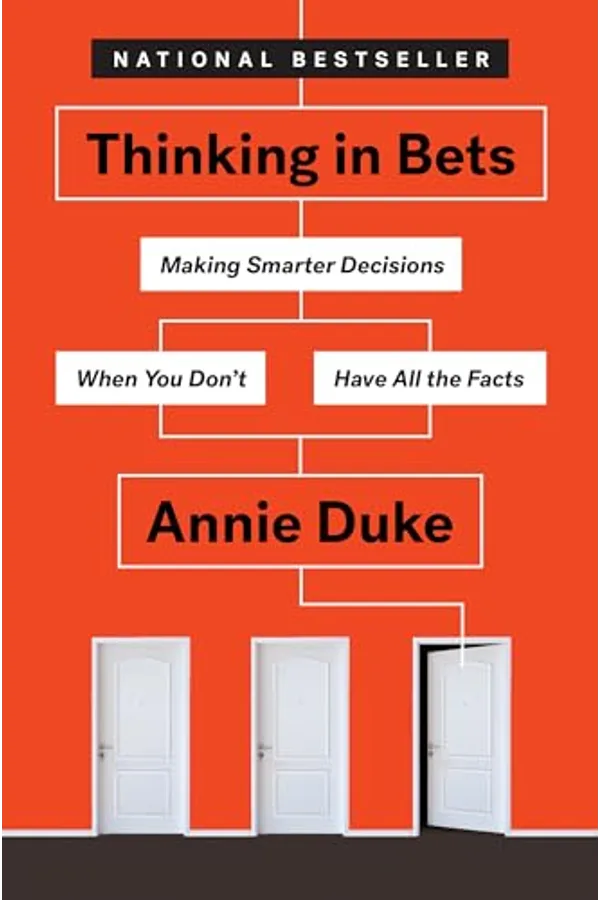
What is Thinking in Bets about?
Every decision is a bet on an uncertain future; quality decisions and good outcomes are not the same thing.
Who should read Thinking in Bets?
Founders, creators, and operators making calls without complete information.
Key ideas from Thinking in Bets
- Separate decisions from results ('resulting')
- Think in probabilities, not certainties
- Seek truth over being right.
Is Thinking in Bets worth reading?
Frees you to take smart risks and stop overreacting to variance in content, markets, and bets.
Best for
Creators and founders whose results arrive with heavy variance and whose confidence swings with the last outcome.
Not ideal for
Readers seeking the cognitive-science depth of Kahneman, this is the applied, story-first version.
What materially matters
- 'Resulting', the named bias of judging decisions by their outcomes.
- Premortems and backcasting for draining future regret out of present choices.
- How to build a decision group that rewards accuracy over ego.
Practical use cases
- Review last quarter's calls: separate the bet from the payoff before judging.
- Run a premortem before a launch: if this fails in six months, what was already true today?
Pros
- Poker stories make probability visceral without a single equation.
- Immediately usable vocabulary, naming 'resulting' half-defeats it.
Limitations
- A slim core idea padded with repeats.
- Less rigorous than Kahneman; reads as a companion, not a foundation.
Thinking in Bets FAQ
Is this just poker stories?
The poker is scaffolding; the book is a decision-review protocol you can run without cards.
Can it help with content strategy?
It is built for exactly that: publishing is a high-variance bet stream where outcomes are noisy.
Continue · Strategy