My take
Strategy works by shaping another party's expectations; sometimes restricting your own choices makes your position more credible and therefore stronger.
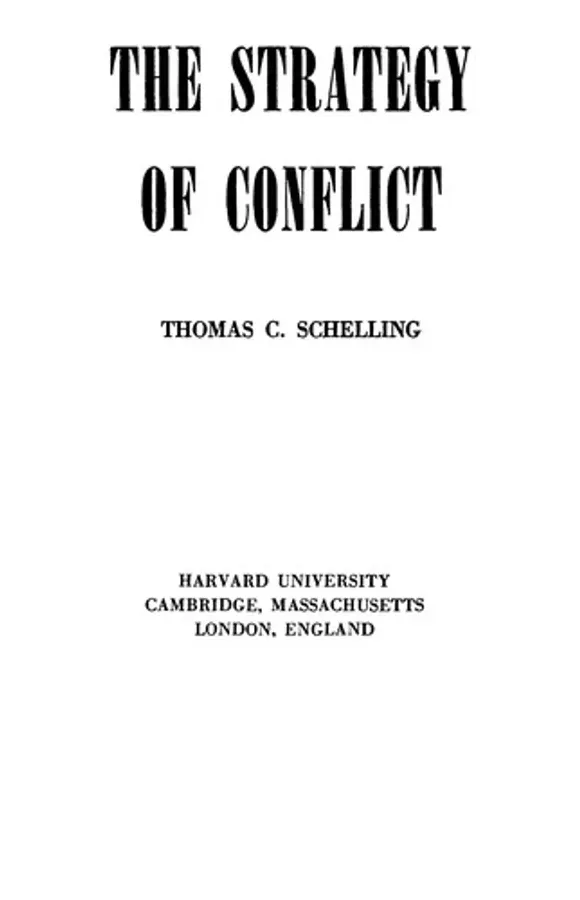
What is The Strategy of Conflict about?
Conflict is usually mixed-motive rather than purely adversarial. Bargaining power comes from credible commitments, communication, focal points, and the deliberate management of risk and expectations.
Who should read The Strategy of Conflict?
Negotiators, founders, policymakers, product leaders, and strategists dealing with interdependent decisions.
Key ideas from The Strategy of Conflict
- A credible commitment can outperform flexibility
- Coordination often converges on salient focal points
- Threats work through expectations and must leave room for compliance
- Controlled risk can become bargaining power
- Most conflicts retain some shared interest.
Is The Strategy of Conflict worth reading?
It explains the structure underneath negotiations, partnerships, pricing, platform coordination, diplomacy, and any situation where each side's best move depends on the other.
Best for
People designing negotiations, incentives, partnerships, or competitive moves where every participant anticipates the others.
Not ideal for
Readers wanting scripts, sales tactics, or a linear how-to; Schelling offers models for thinking rather than ready-made language.
What materially matters
- Credible commitments, threats, promises, and the strategic value of limiting choice.
- Tacit bargaining and focal points: how people coordinate without explicit communication.
- Brinkmanship, deterrence, and the deliberate use of uncertainty in bargaining.
Practical use cases
- Design a negotiation by mapping commitments, fallback positions, signals, and shared interests before discussing tactics.
- Diagnose coordination failures in teams, communities, markets, or multi-party partnerships.
Pros
- Concepts transfer cleanly from diplomacy to business, products, partnerships, and everyday negotiation.
- Mostly conceptual rather than mathematical, making serious game theory accessible to general readers.
Limitations
- Cold War examples dominate and require translation into modern contexts.
- Descriptive strategic tools can be misread as endorsement; ethical judgment remains the reader's responsibility.
The Strategy of Conflict FAQ
Do I need to know game theory?
No. Schelling uses concrete cases and qualitative reasoning; a basic familiarity with incentives helps, but the central ideas do not require equations.
Is a Cold War strategy book still useful?
Yes. The cases are historical, while commitment, signalling, coordination, and mixed motives remain central to modern negotiation and platform strategy.
Continue · Strategy