My take
A reminder that the universe rewards looking for the simpler structure underneath the mess, the same instinct behind any good system.
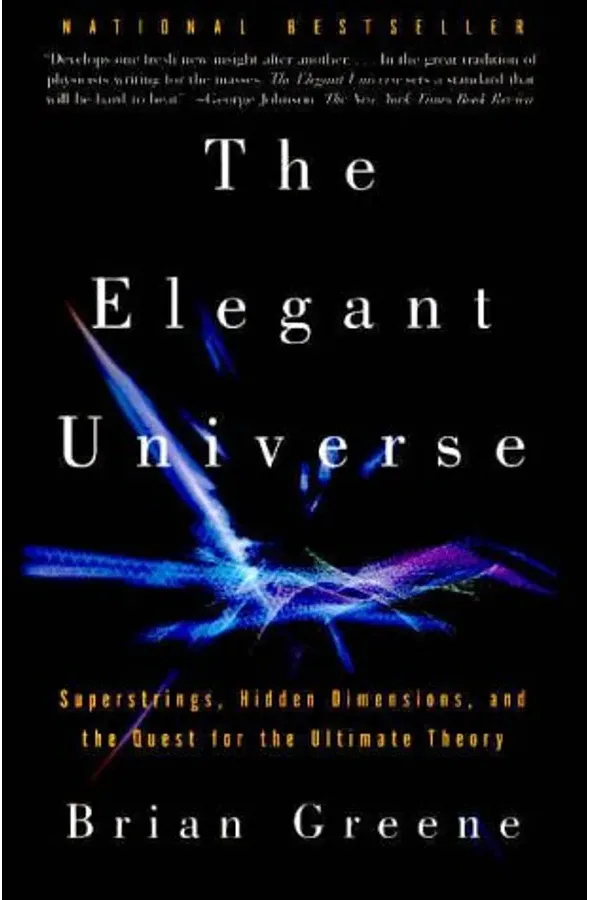
What is The Elegant Universe about?
Reality may be built from tiny vibrating strings, and the deepest laws of physics are unified by mathematical elegance.
Who should read The Elegant Universe?
Curious minds, first-principles thinkers, and anyone chasing the big picture.
Key ideas from The Elegant Universe
- Elegance signals truth
- Seemingly opposed laws can unify
- The frontier rewards imagination.
Is The Elegant Universe worth reading?
Makes the most abstract physics intuitive, and models how to seek one clean framework beneath competing complexity.
Best for
Builders who love first-principles thinking and want the deepest popular account of where physics stood at the millennium.
Not ideal for
Readers wanting current theory, post-1999 developments (multiverse debates, string theory's criticisms) are absent by definition.
What materially matters
- Relativity and quantum mechanics built up from zero with the best analogies in popular physics.
- The unification problem stated clearly: why the two pillars contradict at the extremes.
- String theory and the eleven dimensions, with the Calabi-Yau shapes made almost visual.
Practical use cases
- Rebuild your intuition for how deep technical fields explain themselves to outsiders, useful for any technical communicator.
- Stretch your abstractions: it is a gym for thinking about systems no one can directly observe.
Pros
- The gold standard of science writing for lay audiences, no equations, no condescension.
- Honest about what is established versus what is speculation, chapter by chapter.
Limitations
- The string-theory enthusiasm has aged; later results left the program contested.
- Long and dense in the middle, the dimension-counting chapters test casual readers.
The Elegant Universe FAQ
Is string theory still taken seriously?
It remains mathematically influential but has lost its near-consensus status; read the book as the high-water mark of that era.
Do I need math?
No, Greene's analogies carry the entire argument without a single equation.