My take
Shows that true breakthroughs happen when you prioritize imagination over brute-force calculation.
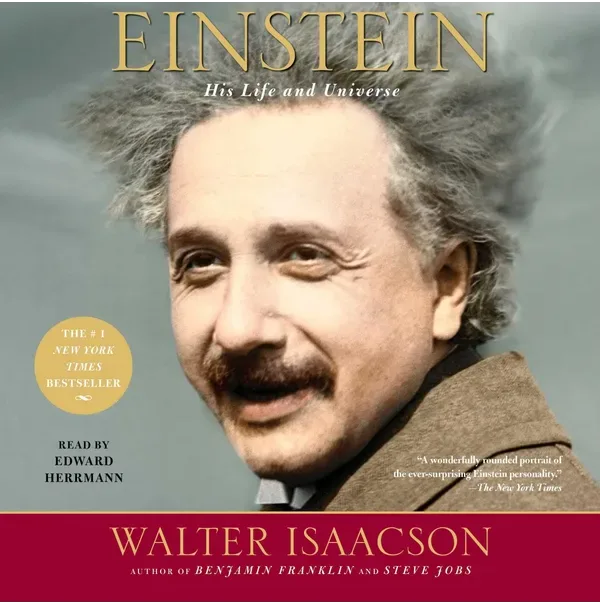
What is Einstein about?
Imagination as the primary engine for scientific and conceptual revolution.
Who should read Einstein?
Researchers, grand-scale thinkers, and rebels.
Key ideas from Einstein
- Question the obvious
- Visual thinking overcomes math
- Rebels drive the frontier.
Is Einstein worth reading?
Proof that true breakthroughs happen when you prioritize imagination over brute calculation.
Best for
Builders and thinkers who work by constructing mental models first, and anyone who suspects rigor and imagination are rivals rather than partners.
Not ideal for
Readers wanting popularized physics, Isaacson keeps biography primary; the relativity is explained, but gently.
What materially matters
- The patent-clerk advantage: how distance from academic orthodoxy shaped his 1905 papers.
- Thought experiments as method, visualizable scenarios carrying rigorous implications.
- The political Einstein: pacifism, Zionism, and civil rights, science embedded in its century.
Practical use cases
- Borrow the method: render your hardest technical problem as a concrete mental image and argue with it.
- Calibrate against late-career rigidity, schedule your own assumptions for review.
Pros
- Access to personal letters humanizes the myth without cheapening the achievement.
- Balances the genius with the costs, marriages, estranged sons, and the price of the persona.
Limitations
- Physics chapters oscillate between too simple for physicists and too dense for lay readers.
- Long; the interwar politics sections run past what the thesis needs.
Einstein FAQ
Do I need physics background?
No, Isaacson explains with analogies; you'll follow the biography fully and the physics approximately.
Is it better than the Steve Jobs biography?
Different, Jobs is a product study, Einstein is a mind study; pick by whether you're building a company or building a worldview.