My take
Most beliefs about the world rest on learned expectations rather than logical proof; clear thinking starts by knowing which kind of claim you are making.
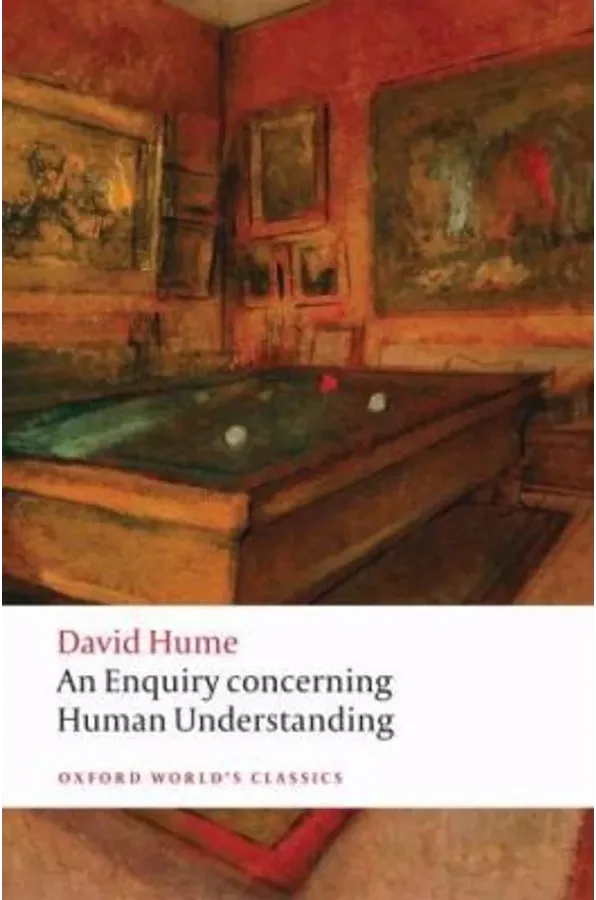
What is An Enquiry Concerning Human Understanding about?
Reason alone cannot establish matters of fact. Our expectations about causes, effects, and the future grow from experience and custom, so responsible belief must respect the limits of the evidence.
Who should read An Enquiry Concerning Human Understanding?
Researchers, strategists, builders, and anyone who wants a durable foundation for judging claims under uncertainty.
Key ideas from An Enquiry Concerning Human Understanding
- Separate relations of ideas from matters of fact
- Treat causal inference as learned expectation, not certainty
- Match confidence to the quality of evidence and testimony
- Use scepticism to improve inquiry rather than paralyse it.
Is An Enquiry Concerning Human Understanding worth reading?
It supplies the philosophical machinery behind modern conversations about evidence, forecasting, science, misinformation, and probabilistic judgment.
Best for
Readers who work with forecasts, research, persuasion, science, or any field where confident claims outrun available evidence.
Not ideal for
Anyone seeking a modern practical handbook or a quick list of critical-thinking rules; this is a primary philosophical text that asks for slow reading.
What materially matters
- Hume's fork between relations of ideas and matters of fact.
- The problem of induction and the role of custom in learning from experience.
- Analyses of causation, liberty, testimony, miracles, and philosophical scepticism.
Practical use cases
- Audit the evidence chain behind a forecast, market thesis, research claim, or product assumption.
- Improve how you weigh expert testimony, repeated observations, and causal stories.
Pros
- Short enough to revisit and broad enough to reshape how you evaluate claims.
- A primary source whose central problems still structure philosophy and scientific reasoning.
Limitations
- Historical language and religious debates can obscure the modern relevance on a first pass.
- Its sceptical conclusions are easy to flatten into 'nothing can be known,' which is not Hume's practical position.
An Enquiry Concerning Human Understanding FAQ
Is this a good first philosophy book?
Yes. The argument is compact and concrete, especially in the Oxford World's Classics edition edited by Peter Millican, though several sections reward rereading.
Does Hume argue that reason is useless?
No. He limits what reason can prove and explains how experience and habit make practical inference possible despite that limit.