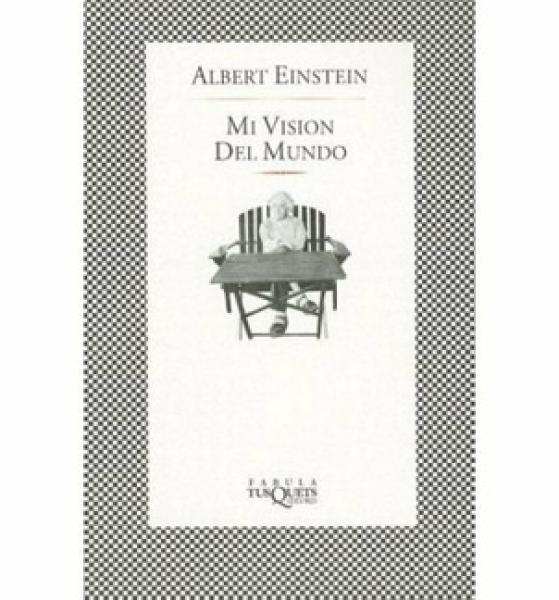
Mi visión del mundo
A compact collection of Einstein's reflections on society, ethics, peace, freedom, and relativity, written for readers rather than specialists.
by Albert Einstein
My take
The useful surprise is how inseparable scientific curiosity and civic responsibility were in Einstein's worldview.
What is Mi visión del mundo about?
Scientific understanding and human responsibility belong to the same worldview: clear thinking should serve freedom, peace, and a more humane society.
Who should read Mi visión del mundo?
Curious readers, builders, and first-principles thinkers who want to encounter Einstein beyond the equations.
Key ideas from Mi visión del mundo
- •Intellectual independence requires moral courage
- •Science needs a human purpose
- •Peace and freedom are conditions for meaningful progress
- •Complex ideas can be explained without hiding behind jargon.
Is Mi visión del mundo worth reading?
It restores the full picture of Einstein as both a scientist and a public thinker, connecting first-principles inquiry with the responsibility to question institutions and inherited assumptions.
How to apply the ideas in Mi visión del mundo
Do not read it as a collection of quotes. Choose a live problem in your work, return to the thesis, and test one idea in context. The value is in the friction between Albert Einstein’s argument and the constraints of your own situation.
Quick verdict
Read it for Einstein's habits of mind and moral clarity, not as a systematic physics textbook or a conventional autobiography.
Best for
Readers interested in first-principles thinking, science in public life, intellectual independence, and the humanist values behind Einstein's work.
Not ideal for
Anyone looking for a chronological life story, mathematical derivations, or a current introduction to modern physics.
Why it is in the Vault
The Vault values tools for clearer thinking. These essays show how curiosity, simplicity, skepticism of authority, and civic responsibility can form one coherent practice.
LV’s perspective
The strongest reading is not 'what would Einstein say today?' but 'what habits let him examine both nature and society without outsourcing judgment?' That question remains useful for builders working inside powerful technical systems.
What materially matters
- •Short reflective pieces on society, religion, politics, economics, peace, and personal freedom.
- •An accessible account of how relativity emerged and what it changed conceptually.
- •A direct view of Einstein's public ethics alongside his scientific imagination.
Practical use cases
- •Use one essay as a prompt for a team discussion about the social responsibility of technical work.
- •Compare Einstein's plain-language explanations with how your own field communicates complex ideas.
Pros
- +Readable without specialist mathematics.
- +Connects scientific inquiry with questions of power, freedom, and responsibility.
Limitations
- −The anthology structure is thematic rather than a single sustained argument.
- −Some political and historical references require context from Einstein's time.
Alternatives to consider
- Ideas and Opinions, for a broader English-language collection of Einstein's public writings
- Relativity: The Special and the General Theory, for a more focused popular explanation of relativity
Frequently asked questions
Is Mi visión del mundo mainly a science book?
No. It combines personal and public reflections with an accessible scientific section on relativity; the wider subject is Einstein's worldview.
Which edition does this Vault entry reference?
The linked Spanish paperback was published by Tusquets Editores in 2005, ISBN 9789871210206 (ISBN-10 9871210205).
Get the free Creator Kit
Frameworks, blueprints, and models for navigating the decentralized internet, free.
Newsletter
·1,000+ readers · weekly · no spam